Showing posts with label Germany 2018. Show all posts

Chapter 14: Flotsam and Jetsam & Other Odds and Ends

In this last and final blog post about our Danube cycling adventure I am going to talk about German bathroom culture, storks, cigarettes, and blankets served with your morning cup of tea.

Our second day cycling the Danube happened to be a Saturday so it wasn't surprising to see large and small groups of cyclists out and about. Some time in the morning we passed a cluster of men, about eight of them, in their fifties and sixties, all wearing yellow cycling jerseys, sitting outside in a beer garden. I assumed they were drinking beer. Why not? It was mid-morning at least. I thought about stopping, too, but we were in a rhythm that didn't call out for taking a break just then. 

A short time later the group shot past us. They weren't carrying any gear so their trajectory was faster than ours. I didn't give them any more thought until later in the afternoon when they passed us again. Before I had a chance to say to Rob, "They must have stopped for another beer," we caught up to them, a row of yellow shirts, lined up almost elbow to elbow one alongside the other standing on the edge of the bike trail facing the woods.  They didn't even bother to step into the woods. I thought, "Wow, this is a free culture."

But it wasn't all that free. A few days later when I tried to get into a public restroom I was stopped at the gate. I needed money to get in. I didn't have any on me. I snuck through the gate when someone came out. 

In Australia every town has a free public restroom. In Germany you must pony up to pee.

Barricades come in many styles.

When my children were younger than they are now I read aloud to them a book called The Wheel on the School, the story of a group of children in Holland who set out to find a wheel to put on the roof of their school so that a stork will build a nest on it and bring luck to their village. When they found a large wooden wheel it began raining and school was closed while all the children stayed home waiting for the rain to stop. When I got to this part in the book, our town was flooding and Kylee and Tim were home from school waiting for the rain to stop. Maybe it was that coincidence that made the book leave a distinct impression on me. Or maybe it was just a darn good story.

I had never realized that storks were such a big deal in other parts of Europe. We found many in Germany. Following are pictures of storks, real and imagined.

This one welcomed us to the small city of Riedlingen.

See the nest up top?

Still Riedlingen. There were too many storks to take a picture of every one.


Nope, not a stork. I found it disturbing that we passed cigarette machines in all sorts of random places, alongside the road in small towns. 

I guess things balance out. You have to pay to go to the bathroom, but in other ways the German culture felt very welcoming.

We enjoyed tea at this outdoor cafe in Ulm where, not for the first time, we found fleece blankets on every chair.

Benches along the side of the bike trails invited us to get off our bikes and rest and relax.

The historic cities and towns all had cafes and restaurants sprinkled throughout their downtown plazas, places to linger over a cup of tea or a beer. We lingered long and often.

We arrived in Pasau on our eleventh day, with an afternoon to spend exploring the city's nooks and crannies before taking the train back to Munich the next day. Thankfully the train back was direct with no transfers, no opportunity for Rob to get off without me.


Neatly packed up, on the train back to Munich.

Chapter 13: For All You Fellow Foodies

When Rob and I bike tour we leave a lot to chance, while trying, at the same time, to make sure we always have enough sustenance to be able to get on our bikes and pedal to our next destination. Our meals can range from Ramen noodles to a rotisserie chicken with a bottle of wine. With our stove and pots and pans we usually do pretty well. But this trip we were traveling light and left our cooking gear at home.  

Our first morning, after a night camped in a public park in Tuttlingen, we packed up our tent and sleeping bags and wheeled our bikes outside the camping enclosure to sit on one of the benches overlooking the playing fields of the community park. It was a quiet Saturday morning, the dew still on the grass, no one else out and about. 

We had no way to cook up a pot of oatmeal or brew a cup of tea for breakfast. But we had a couple croissants bought the previous day. Croissants must be eaten fresh and these were not, but they weren't too bad with the nutella we spread on them, nutella in those little one-serving plastic containers we'd taken from our hotel in Munich. We also had an apple we shared, also from the hotel in Munich, and a couple oranges, the last of the food we'd brought with us from home in New Hampshire. And that was enough to get us on our bikes and on our way.


After about 10 miles we stopped in Friedlingen for a mid-morning snack to supplement our meager breakfast. The restaurant didn't have the morning pastry selection we are used to in the U.S. so we had to settle for strawberry cake. 

Breakfast after a night at a hotel or gasthaus, included in the price of the room, was a bit more extravagant. There was cold cereal and yogurt, hard-boiled eggs and assorted breads. And then there was always a platter that I called lunch. It held several types of cheeses and a selection of deli meats - salami and several types of bologna that were reminiscent of the many pork varieties that my mother's cousin sold in his pork store in Queens, New York.


Most of the places we stayed served breakfast buffet-style. But at the  Gasthaus Hirsch in Riedlingen, we were served our own platter. All this for just the two of us. Do people really eat all this for breakfast? Apparently they do. I snuck a peak at the table next to us where a good-sized husband and wife were enjoying their meal. Their plate was almost empty. I wondered, if this is breakfast, what's for lunch? (By the way, notice the cucumber and tomato slices - also lunch, but a nod to being healthy.)

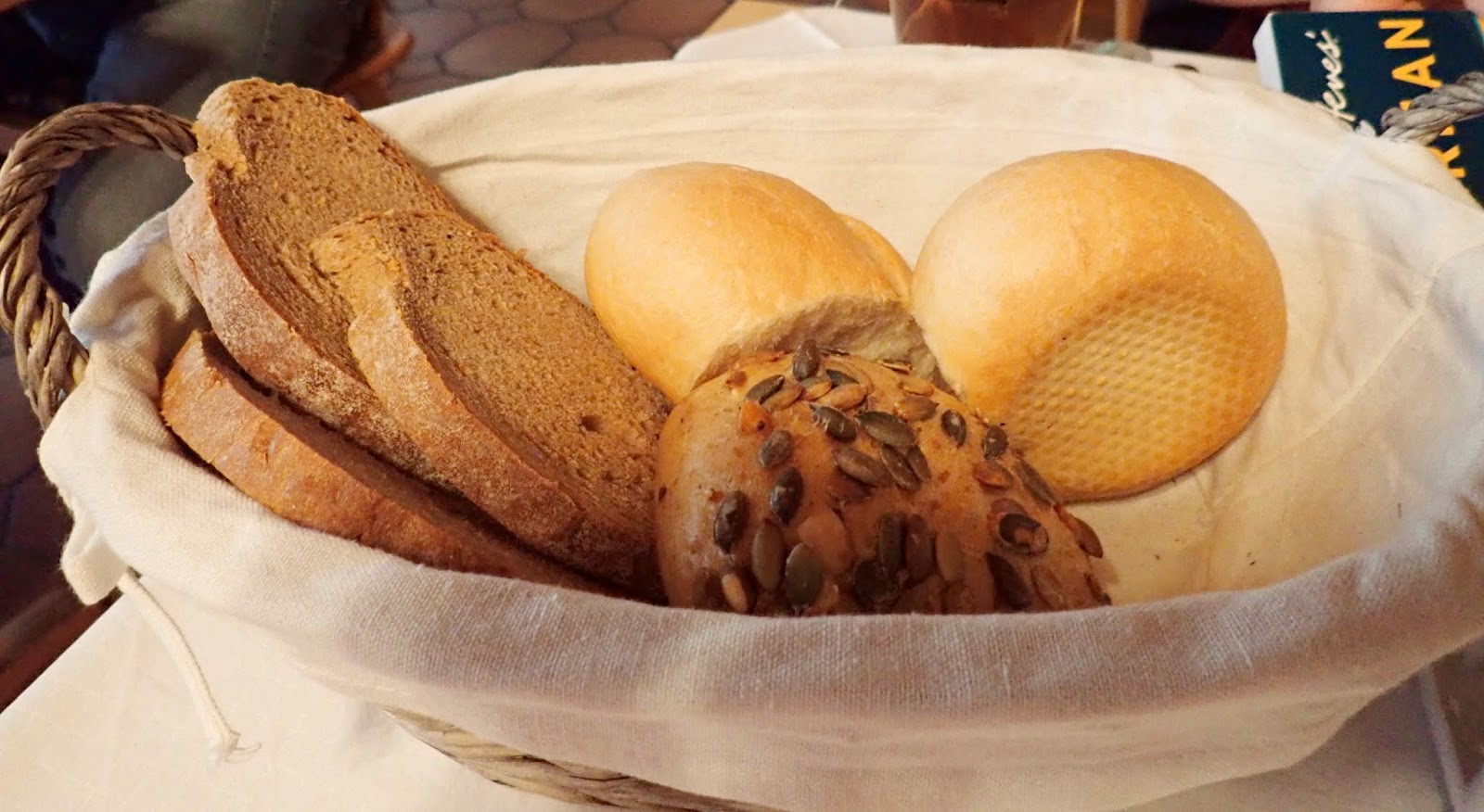
We also had our own basket of bread. Germans seem to be big on bread. When we were in France years ago, I would venture into every French bakery we'd pass for a look at the beautiful artistry of the pastries. In Germany, I did not find any especial artistry in the many varieties of bread and rolls I found in the bakeries. They had pretzels, too, which, honestly, I didn't think were all that great.

My heritage is 100% German. This trip brought back memories of the food my mother and aunts would serve on special occasions, for Sunday dinners, or just a regular weekday meal. Always some sort of meat - it could be pot roast or goulash, Aunt Harriet made a delicious sauerbraten - served with bread balls, potato pancakes, egg noodles, spaetzle, potato dumplings, everything smothered in as much gravy as you could stand. I loved it all, then. 

We were at a picnic held in New York City for our ethnic group recently and the wife of one of my cousins asked, "Did you eat any vegetables?" After some thought I said, "Well, we always had cole slaw. And maybe green beans." But, no, vegetables were never the main feature on our dinner plates.

I don't eat like that anymore. Occasionally I have made goulash, but I have leaned toward mostly vegetarian meals even when my son would insist that he needed more protein in his diet. Now both my kids are vegan. 

But when I sat down to dinners in Germany, I had to give a nod to my upbringing and tried to order those dishes that were reminiscent of my childhood.

On our second night we enjoyed dinner outside an old hotel in Sigmaringen, a short walk from the noisy, crowded commercial campground where we spent the night. I ordered game stew with mushrooms and spaetzle. The blob in the back is pear with whipped cream. It was really good. No vegetables other than that tomato you see.

It was only as an adult that I learned that spaetzle is a noodle dish that you make with a special spaetzle maker. I have one that my cousin sent me when she was living in Munich. My mother made spaetzle by spooning the batter into boiling water so it came out in big clumps like random-sized dumplings. I realize that I am not making it sound very appealing, but it really was delicious. Especially with lots of gravy. We never ran out of gravy. 

One day away from Passau we rode past this small beer garden in Deggendorf. It was only 11:30 but how could we pass it up? Besides, there were already some old folks sitting outside drinking beer. In Germany it's never too early for beer.

The goulash and noodles definitely rekindled those childhood memories. The noodles were nothing extraordinary but the goulash was tender and sweet. And who could complain when there was so much gravy? (Not pictured was a side salad.)

After our lunch we encountered this lovely view of the river.

In Munich many of the restaurants had menus with English translations. Not so much along the Danube. And even with our Rick Steves' German Phrase Book & Dictionary figuring out what to order could take a long time. There were just so many words, and lots that we couldn't find in the book. One night, with the help of the proprietor, I knew I was ordering fish, but not really sure what kind. It came out as a full fish, head included. 

Every time I am served a fish that comes with its head I think of my mother. We were brought up Catholic which meant Friday night dinners were fish, usually swordfish or some type of fillet. But at one point in my childhood my mother decided to get daring and started cooking trout. But she couldn't deal with the head, so we always had decapitated trout. I enjoyed the challenge of pulling the meat away from the spine, leaving the bones behind. I didn't mind the missing head. 

The fish I had that night in Germany wasn't trout but it was moist and tasty, served with a side of potatoes. It's never bothered me to look at a fish head, eyes staring up at me, while I pick away at the body.


Another time we knew we were ordering fish, but not entirely sure how it would be served. We hadn't expected breaded fish, but it turned out to be quite tasty. It came with an assorted salad. We discovered that most salads were an assortment of several different types including shredded carrots, shredded radish, beets, and cucumbers with a dressing of either vinegar and oil or yogurt.

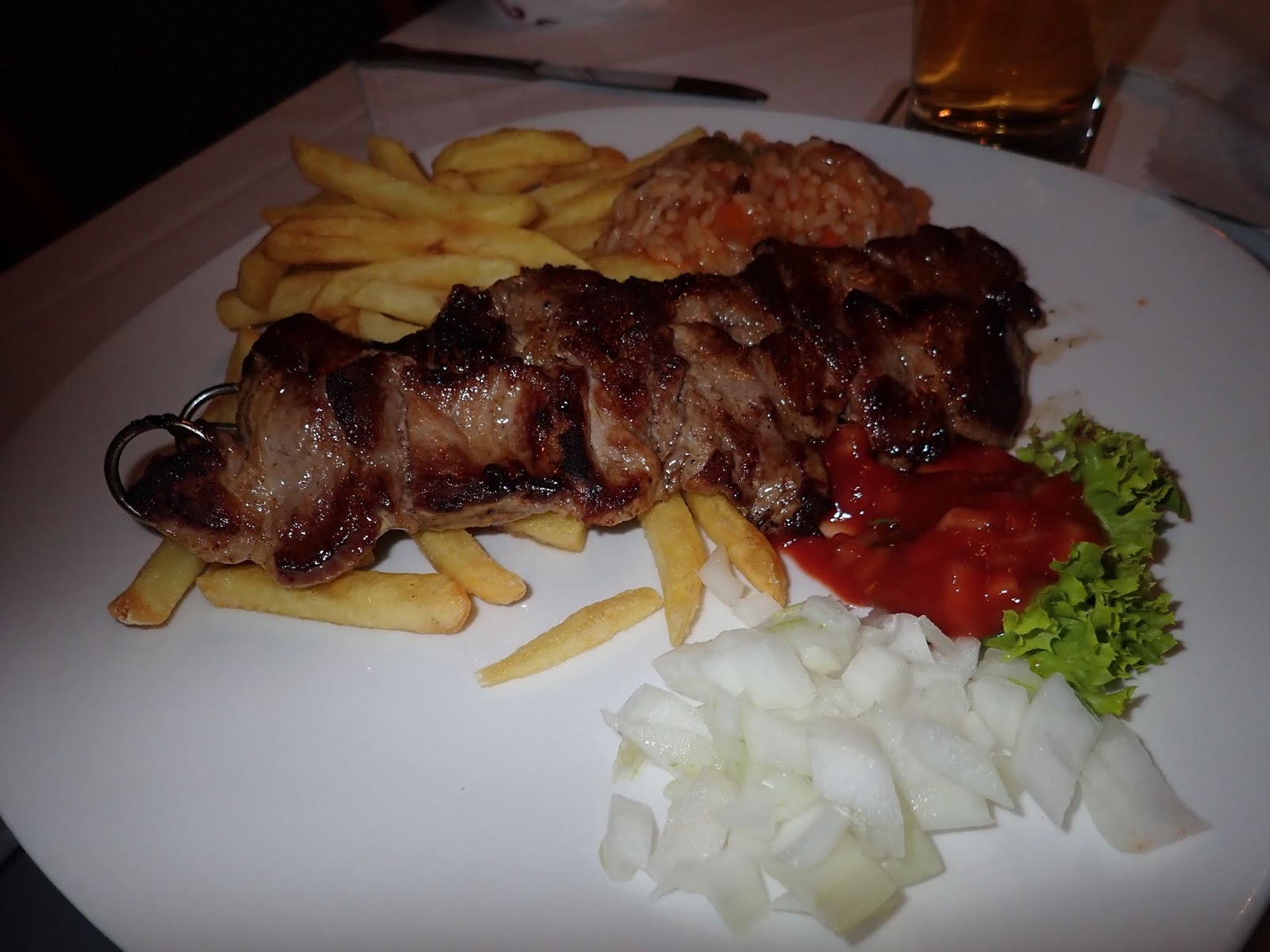
One night, we didn't spend too much time trying to decipher the menu. We'd left our Rick Steves' guide back at the campground and nobody in the restaurant spoke English. By then we recognized a few words on the menu. When I saw a word I knew was rice along with something I knew would be meat I went with it. Rob took some random guess as well. I got the rice part right. You can see it in the back corner. Rice served with french fries was a surprise. The meat might have been pork. It was tender and had a pleasant tasting marinade.


Rob didn't do too badly either, although the egg was a surprise. Who has eggs for dinner? I guess if you are going to have lunch for breakfast then why not breakfast for dinner.


Chapter 12: Going Light

This is us, packed up with just the necessities. We appreciated traveling light this trip. We carried very little food, usually just enough for snacks and a lunch.


Riding along the Danube is a leisurely trip. We encountered many other bicyclists but no one seemed to be in too much of a hurry. Unlike in the United States and Canada where cyclists will tell you about their hundred mile days, people riding the Danube seemed to be pretty unconcerned about meeting any kilometer standards for each day. And they carried loads that ranged from nothing or just a couple panniers, to what appeared to be tents that could serve as grand hotels. I was actually amazed at the loads some people were carrying, older cyclists like us. But, then again, the riding was pretty flat and easy.  

As compared to the other self-supported camping cyclists, we were traveling light. Our packing decisions began at home with considerations for flying with our bikes, which fit in a suitcase and weighed forty pounds. We stuffed ten pounds worth of clothes and other items in among the wheels and other nooks and crannies and checked the weight to make sure we weren't over the fifty pound limit. That was our one free checked bag that Aer Lingus allowed.   

We each had a carry-on (overhead) suitcase where we packed our tent, sleeping bags, pads, rear racks, panniers, riding shoes, and whatever else we could squeeze in and stay under the weight limit of 22 pounds. Sometimes they do check. 

Anything left over we put in our personal bags, which were our handlebar packs and rear rack pack. The only thing we couldn't pack were our helmets. The solution? Wear them! But we just strapped them onto our personal bags and we were good.

We didn't bring our front racks or panniers, or our folding chairs. We figured we could do without warm clothes. We left behind our stove and pots and pans. We packed bowls, utensils and mugs. I was thinking we might buy cereal and have that for breakfast. We didn't, and we never used the bowls. Nor the mugs. Was I thinking  that a neighboring camper would offer us a morning cup of tea if we brought our own mugs? 


It all worked out pretty well. We had no trouble navigating through airports and getting on the bus to and from our hotel in Munich. And once our bikes were put together the train travel was much easier with fewer panniers, especially when we had to negotiate staircases.


[The only thing we didn't bring that I wish we had packed was a plastic jar so that we wouldn't have had to carry a glass jam jar for eleven days. The jam dressed up our breakfasts of croissants or rolls.]

I was intrigued by the camping setups other cyclists had and would have liked to have gotten closer to get better pictures, but that seemed a bit intrusive. I tried to be discreet.


This couple had it all - camp chairs, a table, bottle of wine, a tent big enough to spread out in, and can you see that cooking pot next to the orange pannier? 

At one campground we met a lovely French couple. Between my rudimentary French and their rudimentary English we communicated fairly well. I told the husband that I was impressed with the size of their tent and he said that it was good for stretching out and for eating dinner in when it rained. I told him that you can't eat in your tent in the United States because of bears.

Our French neighbors were packed up and ready for their day's ride. Look at how happy she is. Probably because she got a good night's sleep in their luxurious tent. 


Chapter 11: A Double-Header Day

Our seventh day was our longest ride, 62 miles, and it was the most challenging for reasons other than the distance. It was our hottest day and a good part of the riding was on unpaved roads and trails, with either too much gravel or too much sand, with not a lot of views of the river. I fell once when I got caught in a pile of gravel as I was trying to stop. My foot stayed clipped in and my bicycle was on top of me. I wasn't hurt, but I couldn't get up until Rob came and rescued me.

After three straight hours of riding on dusty back roads we looked forward to visiting the small city of Ingolstadt. Our guide book assured us that it had something for every visitor and, "For hot and tired cyclists looking for refreshment, what could be more welcome than a stein of Bavarian beer? It was in Ingolstadt that the famous Bavarian 'Reinheitsgebot' or 'purity law' was first drafted in 1516 to assure the quality of beer."

Had we not been such hot and tired cyclists looking for refreshment we might have kept going when we saw the cranes and bulldozers and dug up streets and sidewalks as we arrived in the historic part of Ingolstadt.  We dismounted and walked our bikes around chain link fences and over curbs and piles of dirt and gravel. Loud noise from drilling and heavy machinery came from a quaint street of shops and cafes, all dug up. Our search for a quiet resting place became a fool's errand. And then we found an oasis among the rubble.

I felt badly for the young proprietor of the outdoor cafe who was certainly losing business during this tourist season. We were his only customers. But he spoke fluent English. He was the first fluent English-speaking person we met who had the time to have a genuine conversation with us.  As we enjoyed lemonade and cake, sitting outside next to a construction zone where the machines sat quietly, I asked him as many of the questions I could think of that had been brewing inside me all week. 

He told us that in Germany each region has its own brewery so beer companies don't have to spend money on advertising and that there is a law keeping the price of beer low, lower than bottled water. 

I asked him what regular Germans ate for breakfast. Whenever we stayed in a hotel, breakfast was included with the price of our room. It felt like lunch - a selection of cold cuts and cheeses, breads, hard-boiled eggs. I was really curious about what the average German ate.

"They might have oatmeal, or toast, or just about anything," he said.

Small talk done, I wanted to dig down and get an answer to what had been bothering me since our visit to the museum in Munich dedicated to the rise of Naziism. How did so many Germans who lived through the war justify it? He said, "They never thought it would be that bad."

I said, "It was disturbing to see that there were Nazis who held positions of power, spent only a few years in prison and then went back to their lives of great wealth."

He said that Germany has a real debt of gratitude to the United States for its role after the war in helping Germany become the democracy that it is today. We did a lot to bring about justice to the perpetrators of the Holocaust.

"But then the Cold War started and the United States lost its focus on Germany."

He also talked about the impact of the Trump presidency. He said that Europe looks to the U.S. president as a role model and he believes that the rise of hate and antisemitism in Germany is a direct result of Trump's hate speech. I wondered if anything like the rise of Hitler and the Holocaust could happen again in Germany. He said, "No. We're taught from when we start school to never let anything like that ever take place again."

As we talked it became clear that he knew a lot more about our history than many U.S. citizens, maybe more than Rob and me. And, even though he admitted to being a fan of John Oliver, I think he must have gotten most of his knowledge elsewhere; maybe he read books when he was in school.

After sharing lively conversation with us, the proprietor sent us off with a bottle of the local brew. You can't see all the construction in this picture. Believe me, it's there.

The day turned out to be a double-header when we met another friendly fluent speaker of English that night. We had bicycled from our campground into the small town of Neustadt for dinner. Neustadt was a quiet town, so quiet that we were the only customers sitting at the tables set up outside the restaurant. The chef (and owner) came outside and pulled up a chair at our table as we were finishing our dinner. You know those people who can infect you with their happiness? He was one of those people, so content with his life he couldn't imagine doing anything else or living anywhere else.

"I live upstairs with my wife and boy," he said. Later, as we drank complementary schnapps with him, he pointed to a window and began waving. "That's my boy." And we saw a young boy, four years old, standing at the window wearing an undershirt and underpants, ready for bed.

After dinner we enjoyed a complementary glass of schnapps with the chef.


Chapter 10: How Could We Possibly Get Lost?


We never got lost. But not because of my impeccable map-reading skills.

People ride their bicycles everywhere in Germany. In Munich we saw people riding to work in suits and dresses, people carrying briefcases, groceries. Most people don't wear a helmet.

The bicycle racks are usually full so people just leave their bikes wherever, sometimes in the middle of the sidewalk, with the rear wheel locked to the frame.

Given the preponderance of bicycles, it shouldn't have surprised us that, in addition to the Danube path, there were many other bicycle routes in Germany. Sometimes we wondered if we were on the right one.


The sign we needed to follow was the green, yellow, and blue one that said, "Deutsche Donau." Donau is German for Danube.

When Rob and I ride together, I'm the map reader. My handlebar pack has a better way to hold a map so I can read it while I ride. And I like to study maps, to see where we are in the large picture and to confirm that we have not strayed from our path. My kids would make fun of me when we'd travel because I'd always say, "Let's take a look at the map." They're members of the GPS generation.

But it was Rob, who didn't have a map, who kept us from getting lost.

I rode in front, with my map. And at least once a day, sometimes twice or three times, Rob had to call me back for a turn I missed because I hadn't seen a bicycle sign. I'd have my head down looking at the map, or I was just plain oblivious to my surroundings. 

Rob has always been the wildlife spotter when we are on a hike. And on this trip he was invaluable as the bicycle sign spotter. 

Sometimes this was the only sign to follow. But with so many other bike paths out there, how did we know we were still on the Danube path? Rob was sure but I'd insist on stopping to check the map to verify that we weren't lost.

It could get confusing, some of the signs were just too busy. We'd stop and study them. Then I'd check my map. 

Mostly the route was very well marked, even when it took us through out-of-the way places.
We'd hit stretches without signs but a bench along the side of the road told us we were all right. 


We had some lovely stretches where we didn't have to worry about finding our way. We just got into a groove along a stretch of country road.
It was fun to note the great variety of the signs.

Chapter 9: Sprechen Sie Englisch? Nein.

One of my readers has suggested that I include a map of our journey along the Danube. Here's the route along the river, although the bicycle route doesn't follow it exactly.


Rob and I have always been apprehensive about visiting a country where the native language is something other than English. But our second night camping we talked with a young Swiss couple also traveling by bike. The woman assured us that we would have no trouble finding people who speak English. "Especially young people," she said. "Everyone learns English now."

In the next town we stopped in a bakery and I asked the young woman at the counter, "Sprechen Sie Englisch?"


"Nein," she said. 

When Rob and I travel, we love talking to strangers. We never know what priceless piece of advice they will share with us. On a bike trip in Nova Scotia we stopped at a restaurant hoping to get some lunch. It was closed because it was Sunday and it was run by some sort of religious group that forbade working on Sunday, but many of its members were hanging out and said they would give us some soup; they just couldn't sell it. While we were enjoying our free meal, someone asked us, "Are you going to Kejimkujik?" 


Rob shook his head and I said, "We weren't planning on it. Where is it?" 


They explained that it was a national park in the middle of the province, made up mostly of lakes. "You have to go."


So we turned inland and rode 95 miles that day so we could sleep on the shore of a lake in a national park that nobody we know has ever heard of.  We rented a canoe and spent a lazy day paddling down a creek and along the shores of one of the many lakes, watching out for turtles sunning themselves on rocks, and sunning ourselves under a clear blue sky, no motorboat noise to disturb the quiet wilderness. We've returned three times.


How do you get valuable information like this if you don't speak the native language? And we wonder about so many things when we are on the road. What is that agricultural crop we see everywhere? What are those birds hanging out in the fields? Why is the beer so cheap? 

We're both fluent in English. Neither of us has a second language.

Rob struggled with French in high school and got out of his college foreign language requirement by taking a computer programming class. And oddly enough, I believe him. He had to pass a French class to get his Ph.D. and somehow he got through it. But none of it stuck. We went to France several years later. One evening after I placed my order for dessert he confidently said, "Moi, aussi!" I said, "Do you know what you ordered?" and he replied, "I have no idea." 

I studied French in high school and carried that knowledge into a French literature class in college. But I never solidified my book learning into actual skill at understanding answers to my carefully crafted questions.

So every time we ponder traveling in a country where the primary language isn't English, we hesitate. Whenever I ask my well-traveled friends how they get around, they answer, "It doesn't matter. People speak English or you figure it out." They make it sound so easy.

In spite of our friends' reassurances we've pretty much kept our travels to English-speaking countries. We've been to Canada countless times, Scotland, Ireland, England, and Australia.

In 2013 we decided to leave our comfort zones and visit Italy. I  planned every detail. I couldn’t have done it without the internet. If a website was in Italian, I’d hit the translate-to-English key and found all the information I needed. I’d send an email to a hotel and the answer would come back in English. We had every night booked and train tickets bought. We studied Rick Steves' travel guides. We knew which buses we needed to catch and where to sit for the best views. We spent three weeks in Italy and found that, except when we ventured out to some small towns on our bikes, people were happy to practice their English on us. 

Before going to Italy we learned a few key Italian phrases. Prior to getting off the plane in Munich our familiarity with the German language was knowing where we had packed Rick Steves' German Phrase Book & Dictionary.


Our friends didn't lie. We did get by. In one cafe we stopped in, when I asked the proprietor, "Sprechen sie Englisch?" He answered, "Nein." Then he went from table to table, calling out, "Englisch? Englisch?" until a young man stepped up to help us translate. 
With assistance we ordered tea and buttered pretzels, a Bavarian specialty. They were okay, nothing special. We did notice a bicyclist sitting at the table next to us drinking beer. It was 10:45 in the morning. I said to Rob, "I guess it's never too early for a beer in Germany."

When we took the wooden barge through the Danube Gorge to the Weltenburg Benedictine Abbey a couple young men came along to help us understand the boat pilot.


Still, whenever we found someone who was fluent in English and had the time to talk, we peppered them with questions and savored the conversation. We'll value those memories.


But for our next trip we're planning to stay in the United States, where the native language is still English.