Circling the U.S. Chapter 63: Almost to Tucson

Sunday, December 22 - Monday, December 23, 2019


By now we knew that we would be spending Christmas in Tucson. We certainly did not expect anyone in the Warm Showers network to host us for the holiday, but figured we'd give it a shot anyway. And  Cheryl and Chuck invited us to spend both Christmas Eve and Christmas with them. But first, we had to get there.

Sunday morning we left Gila Bend for Casa Grande at 7:45, when it was still getting light. 

We weren't on the road long before Rob said, "Even though we've been on the road for over six months, I still can't believe we're doing this."

And a few minutes later, "I'm always happy to get on my bike in the morning. Are you?"

I said, "Not always."

Rob has never talked about quitting. I don't know if I would still be getting on my bike every day if not for his companionship. Sometimes I just get tired of living out of panniers, and I think about what I would be doing if I weren't on the road. I have a happy life, both in New Hampshire and Colorado. But I made this commitment and there is still much to look forward to, more new places to see. Like Texas.

I added, "I have a muscle in my butt that hurts."

Since we are traveling off the Adventure Cycling route we are pretty much on our own to find the best roads and sights to see in southern Arizona. After returning to Gila Bend from Organ Pipe Cactus National Monument, our next destination was Tucson. We looked to our Warm Showers host in Casa Grande and the head of the bicycle/pedestrian program in Arizona for advice. And riding the interstate won. Which wasn't so bad with light traffic and a wide smooth shoulder. 

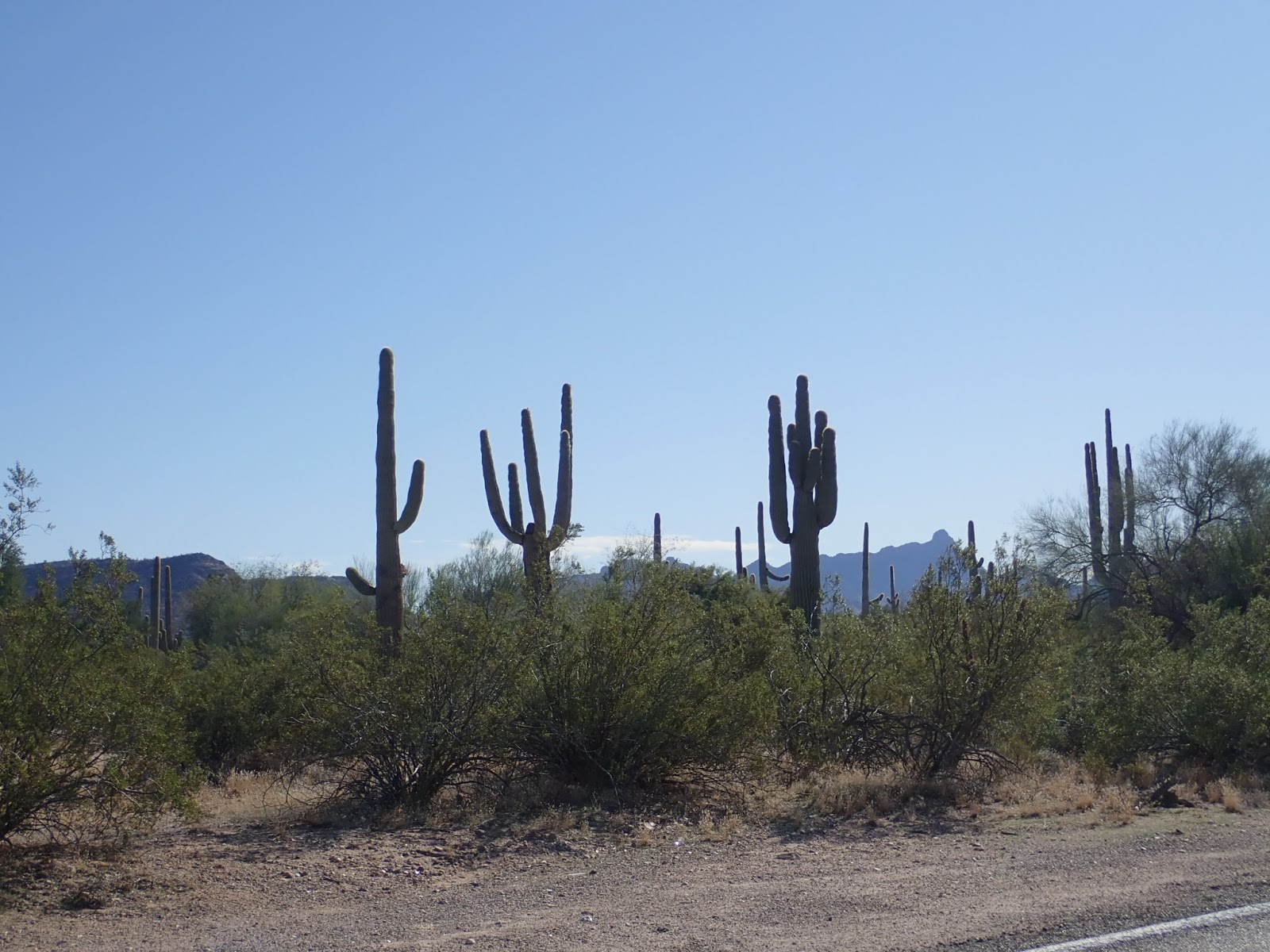
With 60 miles to cover, a gradual climb, and a headwind slowing us to eight or nine miles an hour I didn't stop to take any pictures. The views from the interstate were pretty much what we'd been seeing - mountains in the distance, desert shrubs, and lots of saguaro. Rob and I rode together the entire day, taking turns pointing out the more interesting cacti we each noticed. When we saw a cluster of cacti with more than the usual one or two arms, Rob called it the Catholic community - the more arms on a cactus, the more flowers, and the greater the reproductive capacity.

After leaving the interstate we made good time on State Hwy 84 where we passed what looked to be giant cattle feedlots and a dairy. We found out from Brian, our Warm Showers host, that it used to be the world's largest ranch. John Wayne started it. This is where Temple Grandin did her studies. The cattle never see a pasture. They are fed on hay and only live for 9 months.

After 45 miles we stopped in the tiny town of Stanfield with nothing much besides a convenience store. We both really needed a break so we stopped in for a snack where they had tables we could sit at.
I said, "We've sunk to new lows on this trip." Pepperoni pizza, honey mesquite sausage, and cherry coke, all for only $5.  I don't know about the pizza, but my sausage was delicious. I had it on a pretzel roll. Rob didn't want to acknowledge his involvement in our decadence.

Our bikes are all decked out for Christmas.
After 61 miles we arrived in Casa Grande where we stayed with Brian, our Warm Showers host.
Brian had some fascinating stories and videos to share. His first love is sky diving which he discovered on his 27th birthday. In addition to running camps and winning competitions, he has helped orgainize the world record for the largest parachute formation:  https://www.dropzone.com/articles/events/85-way-crw-world-record-set-r598/
Brian was certainly an inspiration, someone who grabs  onto life and doesn't let go. Not only does he skydive, he also bicycle tours, having done a cross country ride on a tandem with his wife, Pam, who was also a skydiver. But in 2011, he and Pam were out riding and a motorist stuck them, injuring Brian and killing Pam. He has since remarried and has no plans to stop bicycling because, after all, life is full of risks. Unfortunately we were unable to meet his present wife because she is also a skydiver and was in Florida training for a competition.

As I've said before, we've been meeting some pretty amazing people on this trip. 

Monday, December 23, was rough. After 13 miles we had a strong headwind, about 10 mph for most of the rest of the day. I had to work hard just to keep us going about 8 mph. At 20 miles, with 40 more to go, thinking about 5 more hours fighting the wind, I wanted to cry. We stopped for lunch at a Dairy Queen. (We've figured out that we can eat our own food discreetly at fast food establishments, but I did get an order of fries.) Rob tried to convince me that the wind was dying, but it wasn't. The scenery didn't help. We were sandwiched between traffic on the interstate and freight trains speeding by - eight in all - with no saguaros to cheer us on. Only mountains off in the distance looking down on our suffering. 

After 57 miles of hard work, we made it to our evening lodging. Motel 6 isn't much, but we had only a short walk to the Mexican restaurant that Brian had highly recommended. I enjoyed grilled vegetable fajitas and Rob had his usual burrito. 

Following are some pictures from the day, a study in what to worry about in this part of the country.
"Flash Flood Area Next 4 Miles." We've left the danger of tsunamis on the west coast. Now we have to worry about flash flooding.

"Do Not Enter When Flooded." Over the course of many miles we'd see one of these signs after another. If we couldn't enter the dip in the road in front of us, we also wouldn't be able to go back.


I'm guessing the water would rush under this bridge, taking anybody in the dip in the road with it. I said to Rob,"I can't see anywhere we could go." He said, "Climb up on the bridge." 


I said, "There's barbed wire. What would you do then?"
Not even stopping to think about it, Rob said, "Cry."


Circling the U.S. Chapter 62 : Detour to Organ Pipe Cactus National Monument

Tuesday, December 17 - Saturday, December 21, 2019

Have you ever heard of Organ Pipe Cactus National Monument? Neither had I before last spring during the preliminary planning of a route through southern Arizona. There it sits, on the border with Mexico. A little bit of research told me that, if it was possible, we had to go. By possible I mean were there places to stop for the night without having to camp along the side of the road? There were, if we went straight south and came back the same way.

We left Gila Bend Tuesday morning and had an easy 44-mile ride with a tailwind to Ajo, where we had a Warm Showers place to stay with Margaret and Richard.

There are no towns between Gila Bend and Ajo, just a couple of border patrol checkpoints and some men working on the electric lines. We stopped here for the portajohn. The workers gave us some gatorade. I gave them one of my business cards.

We came to a gap in a rock formation that was heavily populated with saguaro. I stopped often to take pictures.


We set up our tent in Margaret's fenced-in yard. The building is her bath house. She lives in the camper, sometimes with Richard. She warned us to be sure to close the gate at night to keep the javelinas out. 


On Wednesday morning, December 18, Margaret gave us a tour of her property. She came to Ajo to care for her mother and stayed after her mother passed away. When she bought her property she thought she'd build a house but then decided she didn't want anything she couldn't easily walk away from.
This is the remnants of a cholla (pronounced "choya.")

This is what the inside of a saguaro looks like.

Margaret told us that the light green colored plant in the middle is a type of cholla (there are seven kinds) called "jumping cholla" because it will attack you if you get to close. A ranger in the national monument told me that another name for it is "teddy bear cholla." "Why?" I asked. He shrugged his shoulders. "Probably someone had a sense of humor." Everything in the desert has thorns.


The javelinas head home in the morning to get some sleep. They are not technically pigs but are peccaries. Rob was sure he heard them grunting outside the fence in the night.

That's Margaret showing us some of the plants in her "front yard." She's my age but doesn't look it and she has an incredible amount of energy. In the summer she leaves the heat of Ajo and goes white-water kayaking.


Blue Agave

Aloe Vera
We left Margaret and rode 37 miles to Organ Pipe Cactus National Monument where we camped for the night in Twin Peaks Campground. Everything about the day was stunning. We saw not just the occasional saguaro but hundreds of them, stretching out forever. And ocotillo and cholla. Then after we entered the park, we began seeing organ pipe cactus.


.


Rob wanted me to take this picture to show how tall the saguaro can get. They grow very slowly and can live to be several hundred years old. There is no way to accurately date them - no rings to count - the age estimate is mostly from observation. After about 80 years they are fully mature and will begin sending out arms, while still growing. They only produce flowers on the ends of their arms or main trunk, so the more arms they have the more children they will produce.


The Native Americans believe that the spirits of the dead come back as saguaro. Some of them truly have a unique character in the gestures of their arms. The arms will drop when the cactus is stressed by cold.

This is a barrel cactus. They don't grow very tall. The yellow things on top are the fruit, edible but not very tasty, I'm told.


We stopped often to take pictures. There were so many unique cactii to photograph. I loved how the fields were filled with thousands of saguaro.


When we arrived at the national monument visitor center Rob said to me, "My chest hurts; my stomach is in a knot," and I almost thought he was having a heart attack but for the huge smile on his face. He continued, "I feel the same way I felt when I caught my first fish. I am that moved by this scenery."

After setting up our tent and taking cold showers (solar heated water didn't last past 3:00) we went for a short loop hike up a ridge. Somehow we got off the trail and Rob was attacked by a jumping cholla. He stepped on one of the bunches of thorns and one got into his ankle. It was scary how difficult it was to get out. Fortunately we saw some other hikers who hadn't gotten off trail and we were able to carefully bushwack our way back to it without any more thorny attacks and saw a spectacular sunset.


I'm standing next to an organ pipe cactus. This one has five arms. We saw one in someone's front lawn in Ajo that had about thirty. This type of cactus is mostly found further south in Mexico; the national monument was created to protect it here in its most northern reach.

Rob insisted that I take this photo. I'm not sure if you can make them out but that hillside is filled with saguaro cactus.


Ocotillo mostly looks like a bunch of dead sticks when it isn't blooming. It can bloom several times a year. After a good rain it will leaf out, then bloom, then it's done until the next rain. It is in its dormant state without leaves; having the leaves stay on would make it lose too much moisture.


An organ pipe cactus with a dead arm lying alongside it. The inside of each arm contains many wooden sticks.

The Sonoran Desert is the greenest desert in the world. I was totally captivated by its beauty. 

Our hike took us to the top of a ridge where we were able to catch the setting sun.


On Thursday, December 19, we went for a short 5-mile hike in the morning before bicycling 25 miles back to Why, where we camped in a private campground. Following are pictures from our hike.

In case you can't figure it out, that's Rob pretending to be a cactus.


Rob is pointing thumbs up at the ocotillo that is filled with leaves and thumbs down at the one that hasn't caught on to the fact that it rained recently. Following are pictures of ocotillo in varying stages of greenery. They will bloom after their leaves come out so it can happen any time during the year. We noticed a few blossoms hanging on to some ocotillo that had already lost their leaves.


A second type of cholla is the chain fruit cholla. The full plant is pictured below.


This is a young saguaro. You can distinguish it from the barrel cactus by the taper at the base.
In recent history the area was heavily mined and the ecosystem almost destroyed. Fortunately, with the creation of the national monument, this beautiful landscape is slowly coming back to life. 

Our hike took us to some of the mining ruins.


An organ pipe cactus sits next to a group of saguaros.


Even though we only spent one night at Organ Pipe Cactus National Monument, we will certainly return. The campground is pristine, wide open with expansive views all around. There are many trails to explore, many off an unpaved loop road.

The bustling town of Why has a travel stop, a cafe that serves lunch and breakfast, and an RV park. 
The town of Why got its name because it was known as "Y" from the shape of the three roads in town. But to have a post office a town has to have at least three letters.


Coyote Howls West Campground is located on the west side of the highway and is only open to RVs. It provides electric hookups and water. We camped on the other side of the highway, in Coyote Howls East, with primitive sites for RVs and tents. As far as I could tell we were the only ones braving the cold in a tent. 

The campground is a vast expanse of sand and cactii. The community room, open 24 hours, houses a library, kitchen area with a sink and microwave, and long tables where people can meet and work on jigsaw puzzles. It appeared that most of the RVers lived there full time, at least for the winter months, enjoying the community the park provides. We met a couple of the residents the following night in Ajo.


On our way out of Ajo on Wednesday we were impressed with a part of town we hadn't seen the afternoon before and wanted to take some time to explore it more. So on Friday, December 20, we took an easy day, riding 12 miles back to Ajo, where we camped again in Margaret's yard. 
Even though I'd taken dozens of pictures on the way to the national monument, I couldn't resist taking just  few more.

Ajo's historic plaza is home to a visitors center in the old train station, a library, and a coffee shop where we had tea and pastries and then lunch while I worked on this blog.

In the afternoon we walked uphill and slightly out of town and past the site of the old copper mine to the local museum housed in an old Indian mission.

The copper mine, once the driving economic force in Ajo, closed in 1983.

When we were picking up dinner at the Family Dollar store, Rob got talking to the gentleman behind us in line. After finding out he was from Montana, they began sharing bear stories. As we were leaving the store, he told us about the fish fry put on at the local VFW across the street. Rob told him we were on a budget and he said he'd buy us both dinner and a beer.  

Larry Hill, who bought us dinner, is on the right, and his friend Linda is next to him. They are both winter residents of Coyote Howls East Campground in Why. Larry's wife is in a memory care unit in Minnesota. He has three sons who live in Minnesota, Montana, and Alaska and spends many weeks each year visiting them.


After saying goodbye to Margaret on Saturday morning, December 21, we headed back to Gila Bend. As we headed north the saguaro cactii disappeared and it was just scrubby brush. We had only a narrow shoulder to ride on,which we've had before on winding roads in California. Here the roads are straight so you'd think the cars would give us wide berth, but that hasn't been the case. Quite a few passed us alarmingly close, going very fast. There are no "Share the Road" with bicycles signs here. I began looking forward to getting back on the interestate with its wide shoulders. 


We arrived in Gila Bend around 1:30 to check in to the motel we stayed in when we were here Monday night - a good price, clean, modern rooms. We were happy to spend the afternoon relaxing and doing some trip planning. We cooked dinner on a table outside our room - sauteed vegetables with cashews and instant fettucine alfredo with tuna. A pretty good meal overall.

We're looking forward to spending Christmas in Tucson where some Warm Showers folks have invited us to share the holiday with them.