 |
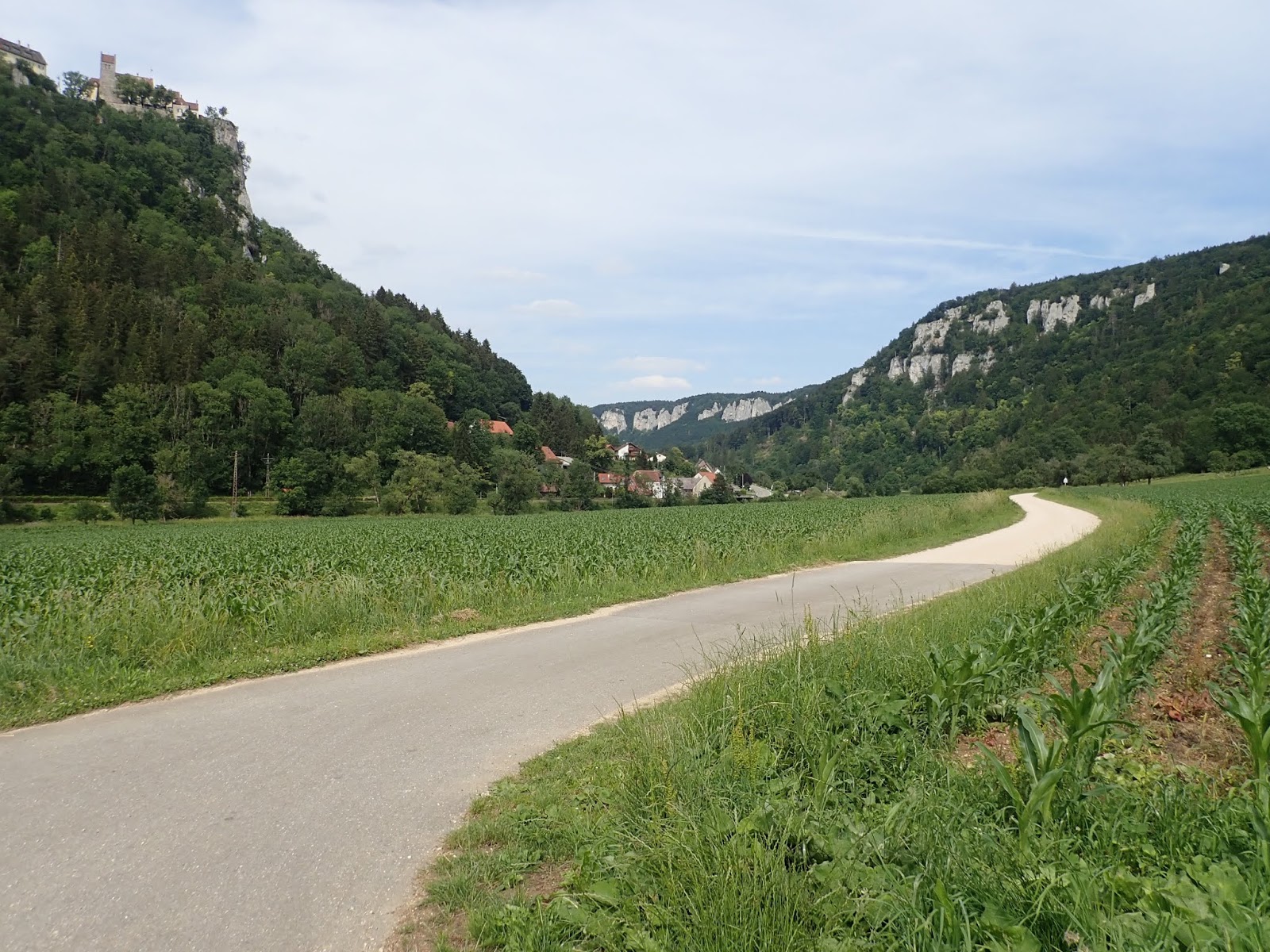
| The bicycle path didn't always hug the banks of the Danube. Often it took us through fields of corn, on narrow paved farm roads where the bicyclists easily outnumbered the occasional car or truck. |
 |
| A couple weeks before leaving for Germany I helped my daughter's friend drive from New Hampshire to Colorado. We saw a lot of corn. In many respects, Germany was no different. We bicycled through many cornfields. It was mostly young or adolescent and I was glad that it wasn't full-grown or we might not have had any views at all. I often thought, "This could be Iowa." |
 |
| But they grow other things, too. This looked like some sort of grain. |
 |
| Wildflowers tucked themselves in alongside the crops. |
 |
| The towns we saw in the distance helped to remind me that we weren't in Iowa after all. |
It was the towns and the culture, way more than the scenery, that made our Germany trip memorable.
There was soccer and beer and the city of Straubing.
On our ninth day, a Saturday afternoon, we arrived in Straubing to find the historic downtown filled with people celebrating the city's 600-year anniversary. Rob and I both found it overwhelming and decided to walk our bikes through the crowd and find the campground we knew was on the other end of the city. After setting up our tent and showering we walked back into town in search of a quiet restaurant for dinner. Then we ventured into the crowd. Bands played on stages set up several blocks apart from one another. People sat at tables drinking beer and eating food from the many stands set up along the sides of the street.
 |
| We saw these tables everywhere, set up in large beer gardens and at festivals where beer was always served. |
Germans love their beer, lots of it. We didn't find craft beers on the menus, and Rob couldn't find any IPAs. We usually had a choice of a pilsner, lager, or ale. Someone told us that the beer is produced by breweries that will serve a particular region of the country so you just get what's available wherever you happen to be. Beer is cheaper than most non-alcoholic drinks - it costs about as much as water - and you could order it in mugs bigger than you would imagine possible. The drinking age for beer is 16.
In the U.S., if there is beer available at an outdoor venue the authorities carefully control where you can drink it. I ran a race recently along the coastline of New Hampshire and beer was served afterwards. Free. I would have loved a beer. I wanted to drink it while sitting on the almost empty beach, letting the waves hypnotize me while digging my feet into the sand. But that wasn't allowed. You had to drink your beer inside a pen with hundreds of other runners and no place to sit down except on some pavement. I skipped the free beer.
In Straubing, you could order a beer and enjoy drinking it while wandering down the street looking for a place to order some food, or sitting down with friends at one of the many long tables set up for the festival. Rob and I didn't order any beer because we'd had some with our dinner and I don't know about Rob but I was afraid I'd have to pee on our walk back to the campground. So we didn't have any beer but instead we walked up and down the street taking in the sights.
And what we noticed was that everyone was gathered around a bar or sitting in an outdoor restaurant watching TV. They may have been listening to one or another band playing, but their eyes and attention were focused on Germany playing Sweden in its second game of the World Cup soccer tournament. Having lost already to Mexico, it was a must-win game. Rob and I had watched the game against Mexico and might have stayed to watch this one, but we couldn't find a place to sit down.
 |
| I don't think these people were waiting in line for beer. |
 |
| You can see the stage set up in the distance, but clearly people were interested in something other than the music. |
We walked back to our campground, next door to a boating club of some sort where the game was playing. I figured we'd be kept up on a Saturday night with partying after the game ended, but it quieted down shortly after we got into our tent. I assumed Germany had lost. But I was wrong. They won. I guess it's just not a part of the culture to go crazy when your team wins. Then again, they still had another must-win game to play in a few days.
Poking around the internet I found an article saying that Germany has a serious alcohol problem. And growing up in a family that is one hundred percent German heritage, I could believe it. But I really did enjoy the laissez-faire attitude around beer. Back in Munich we found a festival on a college campus and sat down for some music and beer and talked to a couple students who were just enjoying some conversation over a couple beers. We noticed families with young children. No one was drunk or loud or rude. Sitting in a beer garden can be a very pleasant way to spend an hour or two.
Also back in Munich we caught the next German World Cup soccer game. This time we were ready for it and found a restaurant where we sat outside and enjoyed dinner and beer while we watched Germany play South Korea. Sadly, they lost.


